



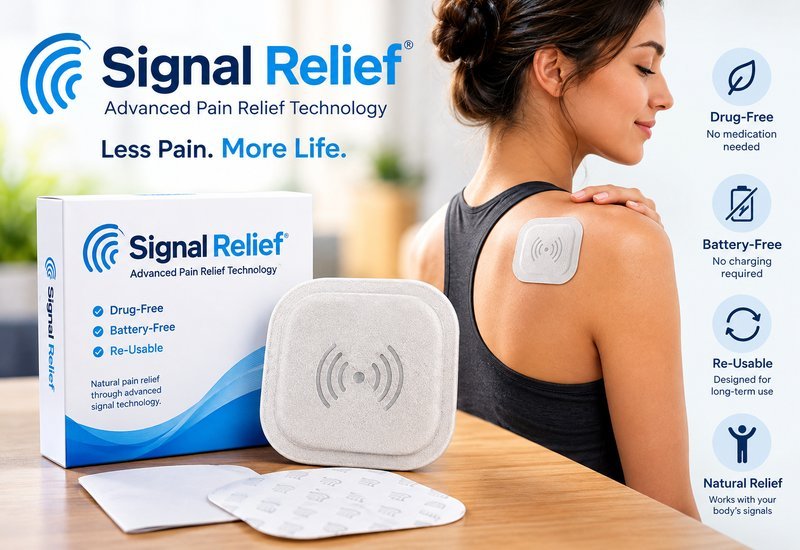
The Signal Relief Patch is a reusable, drug-free wearable product marketed to help reduce everyday discomfort. It uses passive micro-antenna technology and does not require an external battery or medication. But does it really work? A small 2023 pilot study reported improvements in pain scores, while an independent evidence review found that the evidence supporting pain relief remains weak. Understanding the product’s design, research, price, and limitations helps readers evaluate its claims more realistically.
What Is the Signal Relief Patch?
The Signal Relief Patch is a wearable wellness product designed for people experiencing everyday aches and musculoskeletal discomfort. Unlike conventional pain-relief patches that deliver medication through the skin, it is designed to work without drugs or chemical delivery.
According to the manufacturer, the patch contains microscopic components that function like passive antennas. The company proposes that these components interact with electrical signals associated with discomfort. However, this proposed mechanism has not been independently established as an explanation for clinical pain relief.
Signal Relief was introduced in 2019. Company materials identify Mike Hammond as its founder and Daniel Marriott as a founding leader involved in manufacturing. The company markets the patch through its official website.
Here are the main product facts.
| Feature | Details |
| Product name | Signal Relief Patch |
| Product category | Wearable wellness product |
| Intended purpose | Support for everyday discomfort |
| Technology | Passive micro-antenna technology, according to the manufacturer |
| Medication | Drug-free |
| External battery | Not required |
| Reusability | Designed for repeated use |
| Standard patch size | Approximately 4.5 inches |
| Money-back guarantee | 45 days, subject to the published terms |
| Product warranty | Up to one year, according to the manufacturer |
The drug-free design may appeal to people looking for a reusable wellness product. Nevertheless, a product’s design and marketing claims do not establish its medical effectiveness.
How Does the Signal Relief Patch Work?
The manufacturer describes the patch as a passive device containing microscopic components intended to interact with electrical signals associated with discomfort. Its proposed mechanism involves an antenna-like arrangement that supposedly influences how these signals behave.
This explanation comes from the company. More independent research is needed to determine whether the technology produces meaningful benefits and, if so, how those benefits occur.
The Signal Relief Patch also differs from a transcutaneous electrical nerve stimulation (TENS) device. TENS equipment delivers electrical pulses through electrodes, whereas the Signal Relief Patch does not use an external power source to deliver electrical stimulation in that manner.
The manufacturer recommends positioning the patch over or near the area of discomfort, following its instructions. The patch is designed for repeated use, although the adhesive supplies may need replacement.
Important points to understand include:
- Passive technology: The patch does not require a conventional external battery or charger.
- Drug-free construction: It does not deliver pain-relieving medication through the skin.
- Proposed mechanism: The company’s explanation of signal interaction is not the same as a proven clinical mechanism.
- Individual experiences: Users may report different outcomes, and one person’s experience does not guarantee similar results for someone else.
Readers should evaluate the product based on clinical evidence rather than its technical description alone.
What Does Scientific Research Say About Its Effectiveness?
The main question is whether the Signal Relief Patch reduces discomfort more effectively than a placebo or the natural changes that can occur in symptoms over time.
A 2023 study published in Anesthesia & Pain Research examined the patch in people experiencing musculoskeletal pain. Researchers enrolled 42 participants, of whom 32 completed the trial.
Among the 32 participants who completed the study, 24 experienced at least a 30% reduction in reported pain scores. The researchers also reported improvements in other pain-related measurements.
These findings are worth noting, but the study was small and did not include a control group. Without an appropriate comparison group, it is difficult to determine how much improvement resulted from the patch itself rather than other factors.
Read the original paper: A Pilot Study of the Signal Relief Patch for the Treatment of Musculoskeletal Pain.
ConsumerLab published an evidence review on January 8, 2026, concluding that the available human evidence supporting Signal Relief patches for pain relief was weak. This assessment highlights the need for stronger research before firm conclusions can be drawn.
Read the review: ConsumerLab’s Signal Relief Patch evidence assessment.
These findings do not prove that no user experiences improvement. Instead, they show why individual testimonials and small studies cannot establish that the patch consistently relieves pain.
When evaluating a pain-relief product, readers should consider:
- Whether the study included a placebo or suitable comparison group.
- How many participants completed the research.
- Whether the results were published in a scientific journal.
- Whether independent researchers replicated the findings.
- Whether reported improvements were meaningful and lasted over time.
Customer testimonials can describe personal experiences, but they cannot establish medical effectiveness. The most balanced conclusion is that early research has reported improvements, while stronger independent evidence is still needed.
Signal Relief Patch Price, Benefits, and Safety
How much does the Signal Relief Patch cost?
The manufacturer’s official website lists the standard 4.5-inch Signal Relief Patch at $179 before discounts. Its website has also advertised a promotional price of $143.
The following prices reflect the manufacturer’s listed prices before discounts and may change.
| Product | Listed price before discounts |
| One standard patch | $179 |
| Three-patch pack | $479 |
| Five-patch pack | $699 |
| Replacement adhesives | From $25 |
Source: Official Signal Relief website.
Prices are in US dollars. Shipping, taxes, customs duties, and import fees may increase the final cost for international customers. Check the current product page and checkout total before making a purchase.
What are its potential benefits?
The manufacturer promotes the patch’s reusable design, drug-free construction, lack of external charging requirements, and convenient placement near areas of discomfort.
These features may appeal to consumers who prefer a wearable product that does not deliver medication. However, potential convenience benefits should not be confused with proven medical outcomes.
The available evidence does not establish that the patch reliably treats chronic pain, arthritis, nerve disorders, or other medical conditions. It should not be described as a cure or a proven substitute for professional medical care.
Is it safe to use?
The manufacturer advises people with diabetes, circulation problems, chronic pain, skin conditions, nerve disorders, or implanted medical devices to consult a qualified healthcare professional before use. Its published guidance also advises against using the patch during pregnancy.
These are the manufacturer’s precautions, not proof that every possible risk has been fully evaluated. Adhesives can irritate sensitive skin, and the absence of medication does not automatically establish that a product is appropriate for everyone.
People experiencing persistent, worsening, or unexplained pain should seek medical assessment instead of relying solely on a wellness product.
What is the return policy?
Signal Relief’s published policy allows eligible purchases to be returned within 45 days of purchase. The policy requires all patches from a multipack order to be returned together and applies only to purchases made directly through the company.
International buyers are responsible for return shipping, and original shipping fees, duties, and import taxes are non-refundable. Refunds are processed after the returned products are received and inspected.
Read the terms here: Official Signal Relief refund policy.
A money-back guarantee is a commercial return arrangement, not evidence that a product has been clinically proven to work.
Conclusion: Is the Signal Relief Patch Worth Considering?
The Signal Relief Patch is a reusable, drug-free wellness product featuring passive micro-antenna technology. A small 2023 pilot study reported improvements in pain scores, but the absence of a control group limits the conclusions that can be drawn. ConsumerLab’s independent review also indicates that the available human evidence remains weak.
Its reusable construction and lack of medication may appeal to some consumers, but its price and uncertain clinical benefits deserve careful consideration. Readers should distinguish manufacturer claims from independently supported findings, verify current prices and return conditions, and consult a qualified healthcare professional about persistent pain.
FAQs
1. Does the Signal Relief Patch really work?
Some participants in a small pilot study reported reduced pain, but the evidence remains limited. Larger, well-designed independent studies are needed to establish how reliably the patch works.
2. Is the Signal Relief Patch drug-free?
Yes. The manufacturer describes it as a passive, drug-free product that does not deliver medication through the skin or require an external battery.
3. How much does the Signal Relief Patch cost?
The standard patch is listed at $179 before discounts, with promotional pricing sometimes lowering it to $143. Prices can change, so check the official store for current details.
4. Can the Signal Relief Patch replace medical treatment?
No. It should not replace prescribed treatment or medical evaluation. People experiencing persistent pain or underlying health concerns should consult a qualified healthcare professional.
Related Reading: Pulsamento | How Much Is the Signal Relief Patch Price | What Are the 4 Stages of Appendicitis